
TL;DR: Large power swings from AI workloads introduce critical challenges for datacenter and grid stability that cannot be solved by BESS or solar curtailment alone. For facilities with on-site renewables, a STATCOM or a hybrid STATCOM+BESS system is essential for maintaining grid compliance at the point of common coupling (PCC).
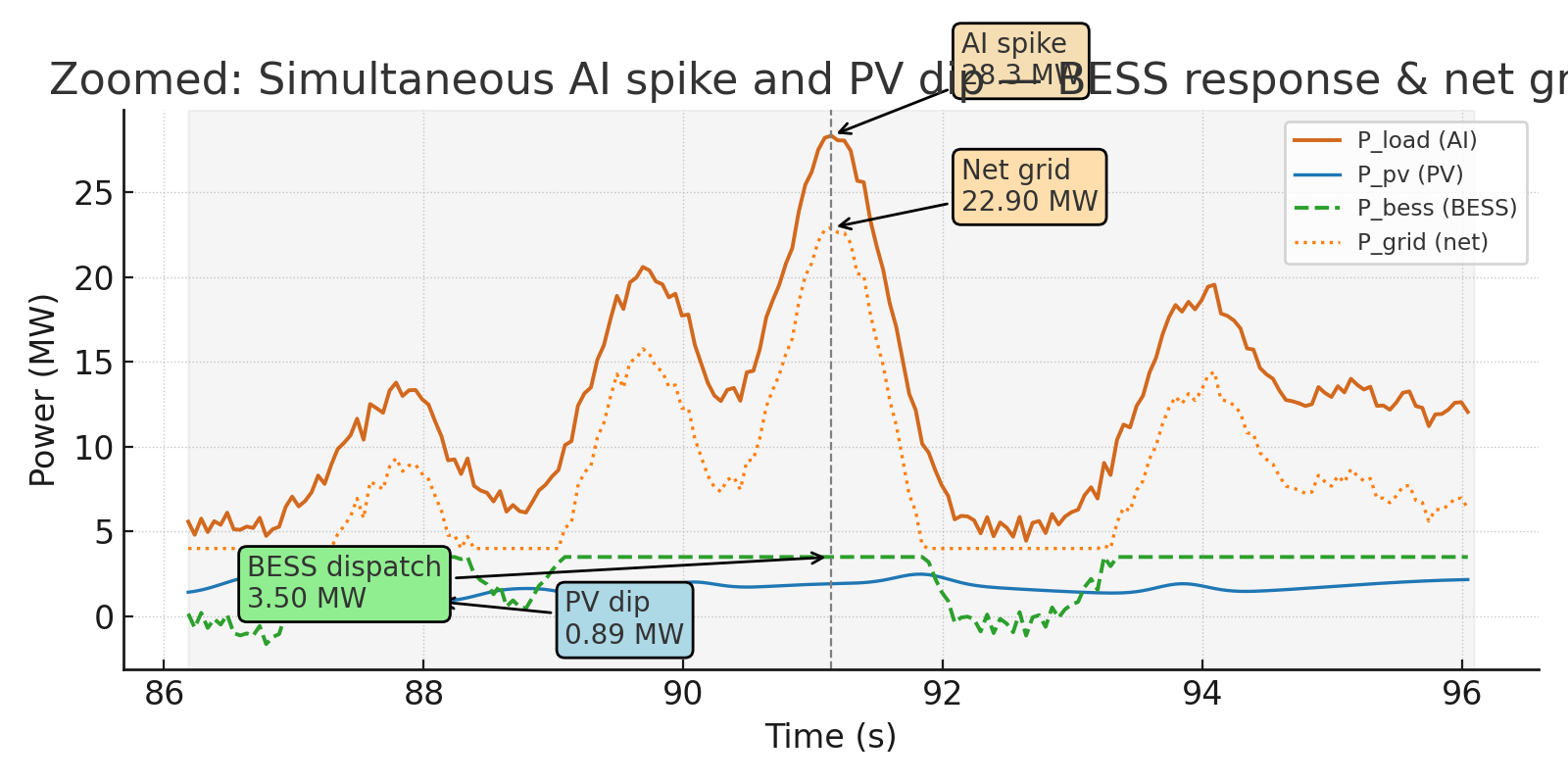
- How STATCOMs help at a PV-fed AI datacenter:
- During PV Swings (e.g., cloud cover): The STATCOM provides fast reactive power to hold PCC (Point of Common Coupling) voltage steady, preventing trips and flicker caused by solar intermittency.
- During AI Training Spikes: The STATCOM mitigates voltage quality issues (transients) but cannot supply the sustained real power (watts) needed for the compute load; this energy deficit must be met by a BESS or the grid. In constrained conditions, PV inverters with headroom can operate in a "PV-STATCOM" mode to provide limited reactive power support.
- Grid Compliance with High PV Self-Consumption: When a datacenter's own PV generation largely covers its power needs, its interaction with the grid is minimal. However, it must still adhere to strict utility grid codes for voltage and power factor at the PCC. A STATCOM provides the necessary dynamic reactive power to ensure compliance, regardless of the facility's net power draw.
1. The AI Workload Challenge: A New Class of Power Disruption
Large-scale AI training clusters present a unique and severe challenge to power infrastructure. Unlike traditional datacenter loads, AI workloads are intensely "bursty" and operate at a much higher power scale. Real-world measurements show that while a traditional compute workload might have a baseline draw of approximately 1 MW with fluctuations of 1-2 MW, an AI cluster has a significantly higher baseline of around 5 MW. Crucially, the power swings on top of this baseline are an order of magnitude larger, with spikes of 15-20 MW that can push the total load to over 25 MW in milliseconds.
This volatility creates two distinct problems: a real power deficit that the grid must supply instantly, and a voltage quality disturbance that can violate grid code. The challenge is compounded at facilities with on-site solar PV, where solar intermittency can exacerbate the power swings.
2. Key Technologies & Their Roles
STATCOM (Static Synchronous Compensator): A STATCOM is a very fast (<50 ms response) power electronics device. While a classic STATCOM's primary role is to manage voltage quality by rapidly injecting or absorbing reactive power, advanced variants offer expanded capabilities. These exist within integrated product portfolios, such as GE Vernova's FACTSFLEX line, and include:
- Grid-Forming (GFM) STATCOMs: These can create a stable grid voltage and frequency reference, rather than just following the grid's signal, which is critical for stabilizing weak power systems.
- STATCOM with Integrated Energy Storage: The most advanced solutions, like the
FACTSFLEX GFMe, integrate a grid-forming STATCOM with onboard energy storage, typically using supercapacitors. This allows the system to inject or absorb small amounts of real (active) power (e.g., a few MW) in addition to reactive power.
Limitation: Advanced STATCOMs with integrated supercapacitors act over an extremely short duration (milliseconds to sub-second). They are designed to provide a burst of active power to counter the initial, instantaneous ramp of a disturbance (e.g., for frequency support), but are depleted in a fraction of a second. They lack the deep energy storage required to supply the sustained, multi-megawatt deficit created by a multi-second AI workload.
BESS (Battery Energy Storage System): A BESS is an energy reservoir designed to act over a much longer duration (seconds to minutes). Its role is to absorb or supply large amounts of real power (MW) to handle the full multi-second duration of an AI workload spike (e.g., 5 to 30 seconds), smoothing the load seen by the grid to address the energy deficit.
Solution (Hybrid System): The most robust solution is a hybrid system that pairs a BESS with a STATCOM. This approach addresses both problems simultaneously: the STATCOM manages voltage quality for grid compliance, while the BESS addresses the real-power deficit.
3. Core Equations
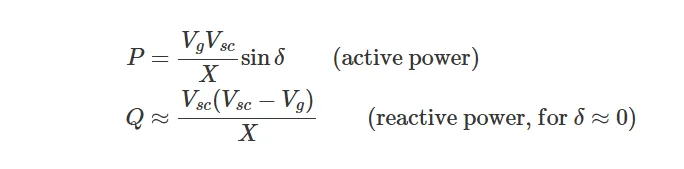
STATCOM Phasor Model
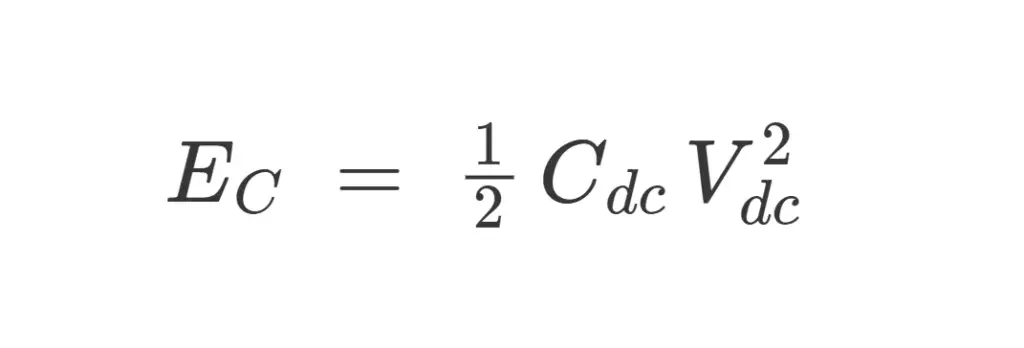
DC-Link Energy
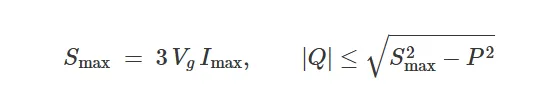
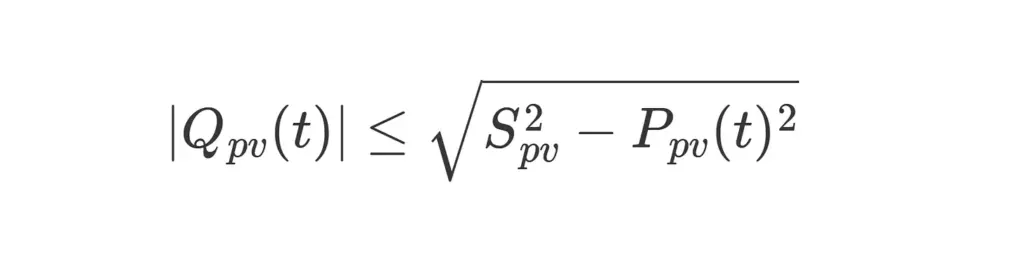
PV Inverter Q Limit
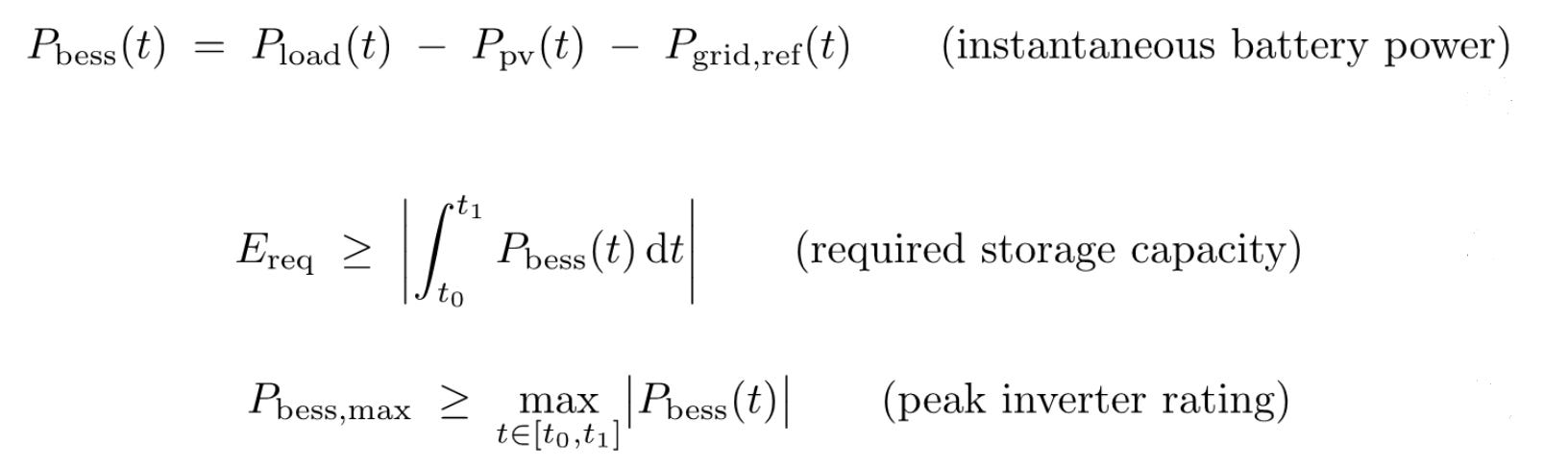
BESS Power/Energy Relations
4. Sizing Examples
4.1 Quick Numeric Intuition
To build a baseline understanding, consider a moderate AI inference spike of 2 MW lasting 30 seconds. The energy buffering required is: E = 2MW × 30s = 60MJ≈16.7kWh. This is a non-trivial battery requirement, and a STATCOM alone cannot supply this energy.
4.2 Data-Driven Worst-Case Scenario
This example uses data from real-world power traces to size a BESS for its real-power role.
- Scenario: Baseline power Pbase=5 MW. AI spike peaks at Ppeak=28.3 MW for Δt=5 s. PV dips by ΔPpv=2.2 MW during the event.
- Effective Deficit Power to Supply:ΔP=(Ppeak−Pbase)+ΔPpv=(28.3−5)+2.2=25.5 MW.
- Energy Required:E=ΔP⋅Δt=25.5 MW×5 s=127.5×10⁶ J=3.6127.5 kWh≈35.4 kWh.
- Nominal Battery (DoD 80%, safety factor 1.5):Enominal≈0.835.4×1.5≈66.4 kWh.
- Peak Inverter Rating: ≥25.5 MW.
- Comment: The energy number (≈66 kWh) is modest, but the power requirement is enormous. The design challenge is delivering ~25.5 MW of instantaneous power. This massive power rating would typically be implemented via multiple parallel modular converters and may involve contractual utility measures like demand response or spinning reserve. This reality motivates the use of hybrid buffering and modular systems.
5. Meeting the High C-Rate Challenge
The sizing scenario reveals that AI workloads create an exceptionally high C-rate requirement, a measure of how quickly a battery is discharged relative to its energy capacity.
5.1 Understanding the C-Rate Requirement
A C-rate is the ratio of power (kW) to energy capacity (kWh). For the AI workload:
- Power: 25,500 kW
- Energy: ~66 kWh (Nominal)
- Calculated C-Rate = 25,500 kW / 66 kWh ≈ 386C
This extremely high computed C-rate is physically unrealistic for a single, standard battery module. Its value is not in providing a direct specification, but in demonstrating the infeasibility of using a standard BESS alone. This is the primary motivation for adopting a Hybrid Energy Storage System (H-ESS) or other specialized high-power solutions.
5.2 Solving the High C-Rate Requirement: Supercapacitors vs. BESS
An AI power spike has two phases: an instantaneous ramp and a sustained draw, each best served by a different technology.
- Supercapacitors (for Power): Supercapacitors have extremely high power density but very low energy density. They are perfect for handling the initial, sub-second transient of the power spike. A system with onboard supercapacitors excels at providing this "virtual inertia" to stabilize voltage and frequency instantly. However, they are depleted in a fraction of a second and cannot provide the sustained energy.
- Batteries (for Energy): Batteries have high energy density. They are essential for providing the sustained 25.5 MW of real power over the full 5-30 second duration of the AI spike. However, a standard BESS may struggle with the high C-rate.
The optimal solution is often a Hybrid Energy Storage System (H-ESS) that combines both:
- Supercapacitors handle the initial, most violent power ramp (the first milliseconds).
- A specialized high-power BESS (using chemistries like Lithium Titanate - LTO) ramps up to seamlessly provide the bulk of the sustained energy.
This hybrid approach protects the battery from the most damaging current surges and ensures both parts of the power-spike problem are solved efficiently.
6. Deployment Options & Tradeoffs
Choosing the right technology depends on accurately identifying the primary problem to be solved.
- STATCOM Only: The correct choice when the primary problem is voltage quality, flicker, or harmonic issues, often related to PV integration or grid code compliance. This solution is not sufficient for flattening the real-power swings from AI spikes.
- BESS Only: A viable option if the main objective is active-power smoothing to buffer AI spikes and the grid connection is strong enough that voltage quality is not a major concern. The BESS must be specifically engineered for high C-rate performance.
- STATCOM + BESS (Hybrid): The comprehensive solution that addresses both challenges. The STATCOM provides high-speed voltage and reactive power control for grid compliance, while the BESS provides the deep real-power buffering needed for load smoothing. This is the commercially proven standard for large-scale renewable projects with complex grid requirements.
- PV-STATCOM (Using PV Inverters): A lower-CAPEX option where existing solar PV inverters are used to provide reactive power support when they have available headroom (e.g., at night or during curtailment). However, its effectiveness is entirely dependent on irradiance, time of day, and inverter thermal limits, making it an opportunistic rather than a guaranteed solution. Curtailing real power (P) increases reactive power (Q) headroom, but at the cost of reduced energy generation.
7. Operational Recommendations & Implementation Plan
A strategic approach is crucial for deploying an effective and cost-efficient stabilization system.
- Audit the Problem:
- Characterize the Need: The first step is to determine if the primary challenge is voltage/flicker (a STATCOM problem) or active-power swings (a BESS problem).
- Collect Data: Use high-resolution monitors (≥100 Hz) to collect at least two weeks of power traces for both the datacenter load and any on-site PV generation.
- Analyze Grid Code: Review the utility interconnection agreement to define the strict voltage, flicker, and power factor limits at the PCC.
- Select the Right Tool:
- Choose Technology: Based on the audit, select the appropriate deployment option from the tradeoffs listed in Section 6.
- Size Components: Use the collected traces and engineering formulas to accurately size the BESS for its power (MW) and energy (MWh) requirements, and the STATCOM for its reactive power range (MVAr).
- Evaluate Vendors: Assess integrated hybrid offerings from vendors with proven utility-scale and industrial deployments.
- Combine with Software & Test:
- Implement Software Measures: Before finalizing hardware size, implement workload shaping, "dummy workloads," or job staggering. These software-level controls can materially reduce the peak power swings and lower the required BESS CAPEX.
- Commission and Test: Rigorously test the fully commissioned system against simulated worst-case scenarios to validate performance against the grid code and operational goals.
8. Sources (Authoritative)
- ABB – VArPro STATCOM (Brocher on dynamic reactive power compensation).
- GE Vernova – An In-Depth Analysis of Power Conversion, Storage, and Industrial Electrification Solutions (Report).
- Sandia / NC State – STATCOM with Energy Storage to Smooth out Intermittent Power (Conference Paper).
- MDPI – Battery Sizing Optimization in Power Smoothing Applications (Journal Article).
Attribution & License
You may reuse this article under CC BY-SA.